Cincy State student presented his food technology research at two industry conferences
Conor McCormick, a senior in Cincinnati State’s bachelor’s degree program in Culinary & Food Science (CFS), presented his research on reducing food waste at the conference of the international Institute of Food Technologists (IFT) in July 2026.
Because of interest from professionals who heard Conor’s talk at the IFT event, he also was invited to present at the Upcycled Food Foundation (UFF) Global Scientific Research Community Symposium III on September 30, 2026.

Professor Grace Yek, Program Chair for CFS, said, “Conor’s presentation is an exciting ‘first’ for Cincinnati State. Conor represented Cincinnati State on IFT’s global stage, presenting his research along with master’s and PhD students from universities around the world. Attendees from academia and industry asked Conor many thoughtful questions about his work.”
Conor said, “The innovations, the products, and the sheer energy of being surrounded by fellow ‘food nerds’ created a special atmosphere, and I felt like I was with family at the ITF event.”
“It’s a privilege to continue present my work at UFF along with many inspiring innovators from around the world who are dedicated to upcycling and reducing food waste,” Conor added.
Mentors for Conor’s project included two CFS adjunct faculty members: Dr. Athula Ekanayake (retired Principal Scientist at P&G) and Dr. Austin Lowder (Food Science Manager at JBT Avure).
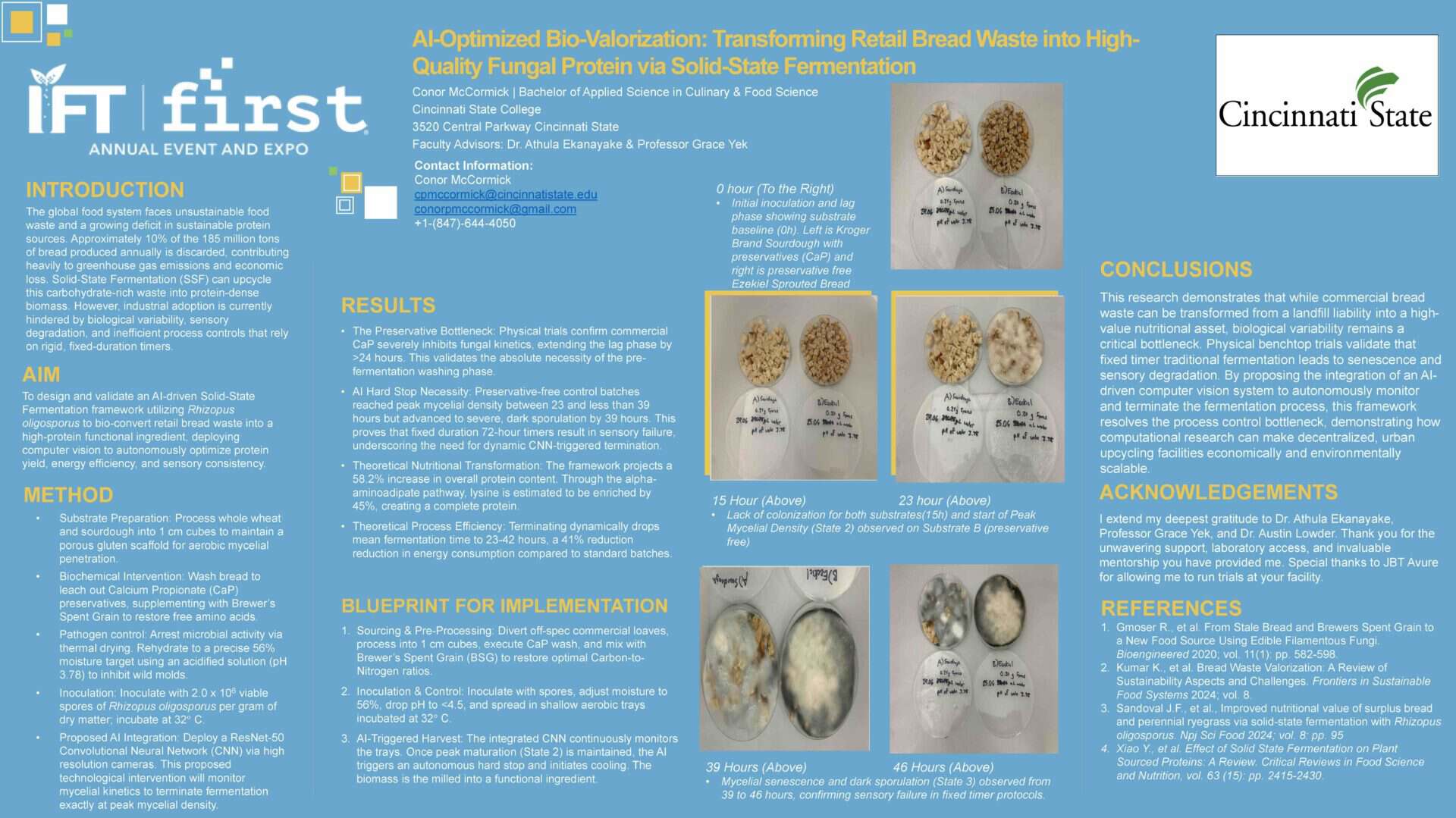
Conor’s research topic, “AI-Optimized Bio-Valorization: Transforming Retail Bread Waste into High-Quality Fungal Protein via Solid-State Fermentation,” examines ways to reduce food waste by transforming retail bread waste into fungal protein.
Conor summarized his work as follows (or keep scrolling to view his full poster presentation):
- The Problem: About 10% of global bread production is thrown away each year, creating massive food waste and greenhouse gas emissions. At the same time, the world is facing a growing deficit in sustainable protein sources.
- The Biological Fix: Conor’s project uses Rhizopus oligosporus, a safe, edible fungus traditionally used to make tempeh (a food made from soybeans), to break down and upcycle this bread waste.
- As the fungus grows, it transforms the incomplete protein waste into a highly nutritious, complete protein by converting Glutamic acid into Lysine through the alpha amino-adipate pathway.
- The Industry Bottleneck: Currently, industrial fermentation relies on rigid fixed timers. Because biological growth is unpredictable, this blind waiting period often causes the fungus to over-mature and produce bitter, off-flavors, essentially ruining the food.
- An AI Solution: Conor proposed integrating a smart camera system, powered by Artificial Intelligence, to monitor the fungus in real-time. The AI visually detects exactly when the fungus reaches peak quality and automatically stops the process. This prevents bad flavors, guarantees a consistent product, and reduces total energy consumption by up to 41%.
This semester, Conor is completing an internship in Corporate Food Technology at Kroger, while also taking 12 credit hours of classes as he continues toward graduation from the CFS program.
(Reporting and photos provided by Grace Yek)